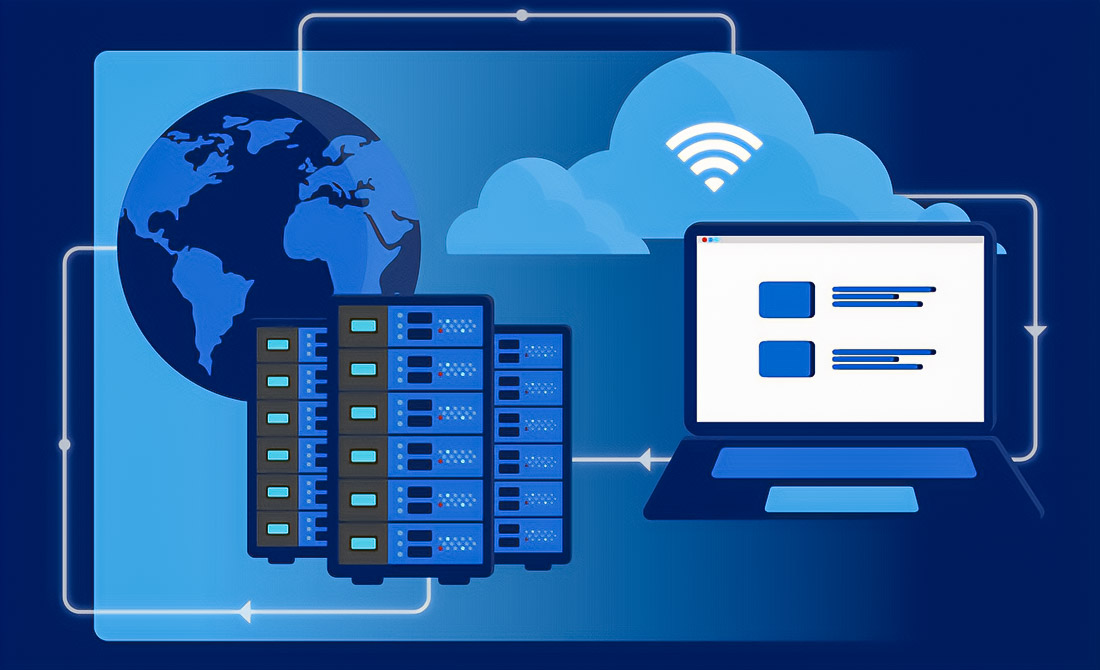
Until a few years ago, the choice of web hosting was often reduced to a basic tariff comparison. How many gigabytes, how many websites, and what’s the price, questions that once dominated the decision-making process around web hosting. In 2026, this approach feels superficial and outdated. Today, the physical location of servers has become a critical factor, directly influencing page load speeds, site stability, and ultimately, user behavior and conversions.
When a person opens a website, they don’t think about network routes or data centers. He just waits for the page to open quickly. If the wait drags on even for a few seconds, attention is lost. The user closes the tab. The decision is made instantly, without analysis or emotion. Therefore, network latency ceases to be a technical detail and turns into a business indicator.
Download Speed And User Behavior

The speed of a website is directly related to the user experience. The faster the server response, the more likely it is that the user will continue interacting. This is especially noticeable on mobile devices, where any delay is felt more strongly. Research shows that pages that load in about one second convert three times better than pages that load in about five seconds. At the same time, just one additional second of waiting can reduce mobile conversions by up to 20%.
Search engines closely monitor such signals. An increase in the bounce rate, a reduction in session time, and sudden exits from the page all worsen search visibility. Especially in regional queries, where sites compete for the same local audience. More than 90% of users start their purchase with an online search, and over 75% of local searches end with real actions. A slow website in this chain just doesn’t get a chance.
Infrastructure Reliability And Data Control

Speed is not the only factor. Infrastructure reliability plays an equally important role. Even 99% uptime means several days of downtime per year. For sites with online payments, automated requests, or e-mail, this results in lost requests and reduced trust.
Hosting servers locally simplifies fault tolerance management. Short network routes, predictable load, and a more accurate understanding of the work of Internet service providers all reduce the risk of sudden failures. In combination with backup, DDoS protection and constant monitoring, a stable base for the site is being formed.
The issue of data storage deserves special attention. Companies are increasingly thinking about jurisdiction and information control. Even for small businesses, it is important to understand where customer data is physically located. Local storage facilitates compliance with information security requirements and is perceived by users as an additional reliability factor.
Support, Scaling, And Long-Term Sustainability

Technical support in the same time zone rarely makes headlines, but in practice it is critical. When the failure is fixed immediately, rather than after a few hours of waiting, the business continues to operate without loss. Local expertise means a better understanding of regional infrastructure, peak loads, and typical connectivity issues.
In 2026, a website is not just a page with information. It is the center of digital processes. Applications, organic traffic, automation, electronic payments, mail, and analytics pass through it. More than 5.4 billion people use the Internet, and an unstable website is perceived as a sign of low reliability of the company.
At the same time, the role of distributed teams and competence centers is growing. There are already more than 1,600 such structures operating in the world, and their number continues to increase. All of them are built around a stable digital infrastructure. The same principle applies to web projects.
Hosting ceases to be an auxiliary service. It becomes part of the core of the business. Companies that take into account the physical location of servers, download speed, security, and support receive predictable website performance and resilience to growth. In 2026, this is what increasingly determines who will remain in the market and who will lose the audience’s attention.

Fixie owner, dreamer, audiophile, hand letterer and fullstack designer. Performing at the junction of simplicity and elegance to develop visual solutions that inform and persuade. Concept is the foundation of everything else.